Table Of Content
Interdisciplinary staff need a space within the data center to collaborate, a center of operations with advanced monitoring equipment. Both IT professionals and engineer specialists in cooling, humidity, and physical racks should be onsite, available for quick response to outages and access for maintenance and emergencies. They can also provide consultative migration to data center environments for businesses looking to utilize colocation and cloud services. Support teams can also assist with data center network design and managing network configurations for complex multi- and hybrid clouds. DCIM software integrates IT and facility management, offering real-time information on power usage, environmental conditions, and system behavior. A more comprehensive picture means smarter decisions about utilizing infrastructure resources.
Cloud Native
Certify that you can design and implement cloud connectivity, including architecture models, IPsec, and Software-Defined Wide Area Network (SD-WAN) solutions. Demonstrates skills and knowledge in a broad range of fundamentals for the latest networking technologies, software development skills, and job roles. Be armed with the breadth of knowledge and skills to navigate the waters of complex IT projects in network architecture and design. Optimize the applications and infrastructure that connect what matters most to any business — its people, systems, and data. Learn from anywhere, anytime with self-paced courses or take instructor-led courses from academies across the globe. Earn digital badges and prepare for industry-recognized certifications in topics like cybersecurity, networking, and Python.
Data-Intensive Storage
In a world where your company’s data may be scattered between servers far apart and overseas, it makes sense to make this process in shorter, cheaper steps. With the advent of cloud services and mobile technology, it is evident that we have entered an era in which mobile phones can serve as remote visual displays of databases. Today’s competitive brands should favor flexible cloud solutions over more conventional but ultimately less flexible forms of service delivery. When combined, these measures secure a data center’s physical and virtual resources and establish trust with clients who rely on our data security protocols. This can help to bring cloud-like benefits, such as flexibility and self-service, to IT operations. Choosing to implement a private cloud does not change the design or operational considerations of a data center to any major degree.
Applications
Data center architecture refers to the design and layout of a computing facility that houses servers, storage systems, and networking equipment for processing, storing, and distributing large amounts of information. It involves detailed planning of the physical space, power and cooling systems, network connectivity, security measures, and software to ensure optimal performance, reliability, and scalability of IT resources and services. The ultimate goal is to create an efficient, resilient, and secure environment for hosting critical IT infrastructure of modern businesses and organizations. Traditional data center designs are mainly aimed at obtaining floor space and the maximum amount of computing power, often at the expense of energy efficiency and flexibility. These facilities typically use raised floor environments for cabling and airflow management, with power and cooling systems not adjusted to actual demand.
How Meta redesigned its data centers for the AI era - DatacenterDynamics
How Meta redesigned its data centers for the AI era.
Posted: Tue, 28 Nov 2023 08:00:00 GMT [source]
Our facility features cutting-edge capabilities such as waterless cooling, indoor generators, and infinite fuel sources to provide the highest level of convenience, reliability and uptime for our clients. Data centers consume a large amount of energy, so it’s important to consider ways to make the system as efficient and sustainable as possible. This can be done by utilizing technologies such as virtualization and server consolidation, which help reduce the number of physical servers required. The primary objective of a data center architect is to design and deliver a reliable, efficient, and scalable data center that meets the current and future needs of the organization. SANs offer high performance and scalability, but they come with high costs and complex management requirements that demand specialized IT expertise.
A highly skilled tech firm can offer precise guidance in designing your data center build out to satisfy all your company's needs and specifications. An effective data center infrastructure should support the current organizational workload as well as the ever-changing and growing needs of your business. A long-term vision helps to ensure your data center can handle the evolution of your business, and periodic upgrades can also support this goal. Most design dataservices develop solutions that only cater to short-term goals, which canturn into bottlenecks in the long run. Data always grows, so it’s imperative tocreate a futuristic data center system with room for adding upgrades andmodifications.
Managed data centers and colocation Facilities
In this article, we will explore what makes up effective data center designs to help you understand why certain decisions are made when it comes to setting up your environment. While cooling infrastructure might be the primary driving force behind the data center power consumption, the increasing power density of server cabinets is also an essential factor. Fortunately, here we shall be sharing the basic principles of data center networking architecture, which will prove to be a big plus for customers looking to collude their IT assets with a data center facility.

It’s important to consider the size, shape, and location when determining where the data center will be located. The chosen space should also provide easy access to power outlets, cooling equipment, and networking components such as switches and routers. By adhering to these standards, businesses can ensure a standard for data center designing that is both secure and efficient.
Cisco Certified Specialist - Enterprise Network Assurance
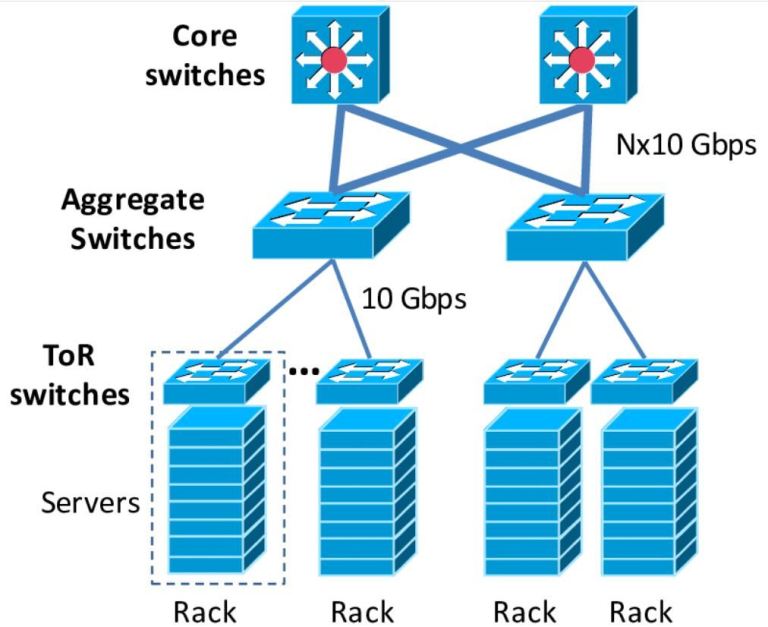
IT solutions and services provider committed to designing and implementing ideal technology infrastructure. The goal of the presentation, as characterized by the Data Center World program, was to instruct attendees on how to think about power requirements for AI racks, and to expose ideas for alternative cooling systems serving AI use cases. The data center network, consisting of various types of switches, routers and fiber optics, carries network traffic across the servers (called east/west traffic), and to/from the servers to the clients (called north/south traffic). NAS provides data storage and data access to multiple servers over a standard Ethernet connection. The NAS device is usually a dedicated server with multiple storage media—hard disk drives (HDDs) and/or solid state drives (SSDs). The choice of form factor depends on many factors including available space in the data center, the workloads being run on the servers, the available power, and cost.
They also oversee data routing to aggregation and edge switches, as well as direct connectivity to computing hardware through horizontal cabling. This hierarchical structure ensures organized and efficient connections to individual racks, servers, and storage devices. Redundancy levels are critical for ensuring high availability and fault tolerance in data center design.
Climate change, environmental management, global energy efficiency, and sustainability on a macro scale, along with joint efforts, can encourage sustainable development. Collaboration and knowledge sharing are key to enhancing continuous improvement in this industry for more energy-efficient data centers. Industry associations, research institutions, and state agencies contribute significantly to disseminating and sharing knowledge about good governance models and setting industry standards. McLean noted how slow growth in power density over a decade in the industry has suddenly leapt into significant growth in power design for data centers, with increased compute capabilities. This connects servers (physical and virtualized), data center services, storage, and external connectivity to end-user locations. Managed data centers and colocation facilities are often used to house remote data backup and disaster recovery technology for small and midsized businesses (SMBs).
Storage area network (SANs) are dedicated, high-speed networks that connect servers to shared storage devices, typically utilizing the Fibre Channel protocol. If a facility fails to deliver reliable power and connectivity to the networking systems it hosts at the site, it probably won't suffice the business requirements for long. Data center airflow management is just as vital to operations as cooling systems, working synchronously to protect sensitive data and equipment. Computer Room Air Conditioning (CRAC) are cooling units that use chilled water and air to keep the internal environment functioning between set thresholds for temperature, airflow, and humidity. Equipment within servers such as magnetic tape (integral to data storage), is especially sensitive to changes in humidity so it is important to consider the provisions for this when thinking about data centre architecture. These considerations, along with business requirements, feed into choices that determine data centre architecture.
Data centers are increasingly becoming aware of their impact on the environment and are using data analytics and machine learning to change energy management. They rely on complex mathematical algorithms to analyze large datasets in detail, find inefficiencies, predict future power needs, and adapt their activities instantly. Consequently, these data centers can realize substantial energy savings while maintaining maximum performance and reliability. In this era, data exists and is connected across multiple data centers, the edge, and public and private clouds.


No comments:
Post a Comment